On books and arts — Themes and Context

(0 User reviews)   82
Wedmore, Frederick, Sir, 1844-1921 Project Gutenberg 2023 Not confirmed
Literature -- History and criticism; Art criticism; Dramatic criticism Readers of public-domain and historical texts
Project Gutenberg digital edition en

Edition facts

Words 64,045
Reading time 279 min
Text sections 32

Before opening On books and arts — Themes and Context, the edition data offers a quick orientation: 64,045 words, 4 hr 39 min estimated reading time, and 32 detected text sections.

The text analysis averages about 27.9 words per sentence, while the detected sections provide another way to judge how the source is divided.

Project Gutenberg metadata also associates the work with “Literature -- History and criticism,” connecting these edition facts with the source record’s subject description.

Sir Frederick Wedmore's collection of critical essays on literature, drama, and visual art, with a focus on authorial choices in diction, dialogue, and description. Observations traceable to his preface, his analysis of the short story, and his discussion of Dutch painting.
Share
Editorial Edition Score 4.8/5

Calculated from edition completeness, EPUB availability, text structure and catalogue metadata. Not a user rating.

How this score is calculated
  • Description quality20 pts
  • Title & short description10 pts
  • Source metadata20 pts
  • Text length15 pts
  • Chapters / structure15 pts
  • EPUB file integrity20 pts

Total of 100 points, scaled to a 2.5-5.0 range. Editions with an empty description or a missing EPUB file are not scored.

Edition quality

Read the Text

importance was sure to descend--neither the ‘Belle Vue’ nor the ‘Lac’ existed at that period. Let us take courage, however--our trouble was not so useless as I had for a moment imagined it. The actual meeting-place of two friends, two ‘lovers’ (in Walt Whitman’s sense, at all events), is in the end at least as interesting as the meeting-place of two strangers, who were to warm towards each other only in future years. They met, then, we may fairly presume, at the Faucon at Neuchâtel, but met after a correspondence by turns polite and chivalrous, intimate and ardent.

It was no unusual thing for Balzac--the historian, above all things, of men’s ambitions and of women’s hearts--to receive, together with the compliments, the confessions of the fair. In our own age--an age perhaps more enamoured of physical prowess and presence than of intellectual or spiritual achievement--I have not heard that the novelist or the successful writer of the short story is in constant receipt of the confidences and eulogiums of women. These, I am informed, when bestowed liberally on the stranger, are directed, nowadays, in chief to the _jeune premier_ with a rapid action and a well-made coat. But it was otherwise two generations ago; and Balzac, sometimes complaining of the embarrassment, sometimes, on the other hand, with not a little of honest pride in the circumstances that caused it, avows himself endowed with the functions of a confessor. In the two volumes of the well-known _Correspondence_ I have referred to before, and in such other writings as have hitherto been accessible, it is chiefly question of a certain anonymous ‘Louise,’ whom he never saw, to whom he said many pretty things on writing-paper, and to whom he was once minded to dedicate one of his stories. As a rule, I believe, he left unanswered the letters of the stranger--felt, perhaps, that it was enough that they should have been received, and, if they contained anything that was noteworthy, registered, very likely, in the book of his memory for possible employment in fiction. But now it is made clear abundantly, that in the case of Evelina de Hanska, not only was there correspondence, intimate if scarcely voluminous, before any personal meeting, but likewise that by means of it such a tie was created, such a mutual fascination formed, as could hardly with ease be broken. And yet, what if when they met in the flesh there had been--as after all there might have been--disillusionment! What if Evelina de Hanska had proved as distasteful to Monsieur de Balzac as Anne of Cleves to the experienced Henry!

He was in the best of all possible moods, however, to be impressed with Madame de Hanska, during the period of their earliest correspondence; for unquestionably he was wounded, unquestionably he was sore. Among the friendships--verging sometimes on love-affairs--which Balzac formed with women, two were at this moment in the crisis of their fate. Many years before the existence of Madame de Hanska became known to him, Balzac had been friend, trustful dependant, would-be lover, probably--it is difficult to express the relationship--of a certain Madame de Berny. She was a little older than he was, and she helped him in money troubles when he was young enough to be able to accept her assistance without shame, and she knew the world at a time when, if I may proffer the phrase, he joined the inextinguishable simplicity of the artist to the more prosaic simplicity of the inexperienced.

At Madame de Berny’s house in the Oise, Balzac had written his brief and restrained masterpiece, _Le Curé de Tours_. Her difficult virtue, and all her other qualities and characteristics, made, confessedly, much of the interest of _Le Lys dans la Vallée_. That relationship of theirs--into which, as I consider, a morbid element, an exaggerated sentimentality, did at one time to some extent enter--was only wholly broken by Madame de Berny’s death. For two years at least she was the victim of a mortal illness. The illness began, and the depression caused by it in Balzac began, about 1833.

But during the year 1832, Balzac, whose feeling towards Madame de Berny--‘an angel at my side’--must with long years have somewhat changed its character--during the year 1832 Balzac had passed through an experience the end of which he speaks of, long afterwards, as ‘_un des plus grands chagrins de ma vie_.’ And that was his experience with the young Madame de Castries--the Duchesse de Castries she became, in due time, some years later--a light of Parisian Society, fully as fascinating in the quietude of Aix-les-Bains as amidst the distractions of all the _salons_ of the capital. It is not from the letters that Balzac wrote to her--not, at all events, from any that have been published--that we know or can surmise how irresistible for Balzac was her personal magnetism. It is rather from certain amongst the letters sent by him to his life-long friend, his sister’s school friend, Madame Zulma Carraud of Angoulême, that we are informed of the effect of Madame de Castries’ dealings with him. She was at one time a delight, then a disillusionment, and then (and, as it seems to me, ever afterwards) a painful yet attractive memory. The rupture--never a quarrel avowed to the outsider; never indeed a rupture that was quite complete, or that was in any way explicable save under the supposition that the lady of the _belle chevelure venitienne_ had a blonde’s inconstancy and a Scottish caution--the rupture, such as it was, occurred in the autumn of 1832, when Balzac, who was to have gone over into Italy with the lady and her brother, parted from her at Geneva, and consoled himself (let me be permitted to hope) as best he could, by buying, at that famous dealer’s on the Quai des Bergues,[1] a little of the ‘Carl Théodore’ (Frankenthal) porcelain that his soul loved. The ‘collector,’ I am informed, is heartless--but he has his compensations.

[1] Since moved to the Corratorie.

The second of the just published letters addressed to Madame de Hanska contains sentences which are meaningless, if it is not to Madame de Castries that they refer. ‘Only Heaven and I can ever understand the frightful energy with which a heart must be endowed, if, being full of tears that are repressed, it must suffice still for the labours of writing.’ Again--and this time why should I translate?--the cry of a moment: ‘_Toutes mes passions, toutes mes croyances, sont trompées._’ And he tells his correspondent that Madame Recamier at least never sat, as was supposed, for Feodora.[2] ‘I met a Feodora once, but her I shall never paint; besides, the _Peau de Chagrin_ was written long before I met her.’[3] Yet again, ‘I made Feodora out of two women whom I knew, but not intimately. Observation was enough for me--with a few confidences to boot.’

[2] Feodora, the evil genius, one may say, of the _Peau de Chagrin_.

[3] If this was Madame de Castries, the intention did not always hold good, since more than touches of that charmer there are supposed to be in the _Duchesse de Langeais_.

What Balzac seems to have been struck with, from the first, in Evelina de Hanska, was her sincerity and oneness of purpose, the truth of her devotion to his work, and a certain similarity, an immediate sympathy, between his nature and hers. Much of his work, as he avows, has been done to strike the public--to provide the public with that without which it could scarcely accord him the attention he asked. But ‘certainly there are books in which I have loved to be myself; and you will know well which they are, for they are those in which my heart has spoken.’ When at length the two came together, at Neuchâtel in 1833--as in Vienna, and in Russian Poland itself, in later years--there was nothing, it seems, in either to diminish the interest or to break the spell. And the fascination continued. I have for my own part a little theory that the sympathy of the woman, her deep interest in his work, her participation in it (_Séraphita_ and some kindred labour, whatever be its defects, would never have existed but for that influence of this mystic Northerner), gave the attachment, as far as Balzac was concerned, something of the features of an attachment of consolation. His early adoration, as I hold, his boyish passion, was for Madame de Berny. And, in maturer years, his ideal, his very dream of beauty and of charm, was Madame de Castries--Madame de Castries set, so to put it, in the best of her backgrounds: Madame de Castries at Aix-les-Bains. Never, I think, in Balzac’s life was that experience, or the force of it, equalled. But in Evelina de Hanska, whether as friend or wife, he discovered and obtained a steady rest--a rest the more assured, it may be, because she entertained for him feelings of a deeper devotion than any that were extended by that admirable and almost lifelong comrade, his friend, his sister’s friend, the blameless and the wise Madame Zulma Carraud.

An idealist, anyhow, Balzac was at the beginning; an idealist he remained to the end. The ‘_amitiés d’épiderme_,’ as he excellently called them, attracted him but little. In my short book about him, in the ‘Great Writers’ Series, I tried to show that what he sought for and obtained was the intimacy of the heart. Gautier knew this. And one-sided indeed must be those people--whether the word of their choice is intended for blame or for praise--who, judging either by life or work, think that Balzac is properly described as ‘materialist’ or ‘realist,’ alone or chiefly. The Real, which is not always the hideous, he was strong enough to face; yet Romance was essential to him. It is time, now, that the sentimental and _soi-disant_ Romantic began to understand that in Balzac there were depths of feeling and of poetry to which they could never approach; and time also that those tiresome disciples of mere ugliness in literary theme and literary treatment, who account him their yet insufficient master, were informed, roundly, that whatever the lessons he may half-incidentally have taught them, nothing of Balzac’s greatness can ever fairly be claimed as supporting or justifying the narrow limitations of their sordid sect and creed.

(_The Bookman_, March 1894.)

The accounts of George Eliot’s earlier life, which are in general circulation, are in some respects imaginary. ‘George Eliot’--Mary Ann Evans--was not the daughter of a poor clergyman, nor was she ever ‘adopted’ by a wealthy one. She was the daughter of a land surveyor in the Midland Counties, and was brought up at her father’s home, her mother dying when Mary Ann Evans was still a child. Nor was she ever the ‘pupil’ of Mr. Herbert Spencer, nor a frequent writer in the _Westminster Review_. She made the acquaintance and the friendship of Mr. Spencer when she was a woman, and already the mistress of the abstruse subjects in which she then chiefly delighted. She was for a time joint-editor of the _Westminster_ with Dr. Chapman; but her writings in that Review were neither numerous nor generally important. After a residence of some years in Coventry--where she learned profoundly the features of the ‘Midlands,’ which she afterwards described--Mary Ann Evans came to London. At twenty-six years old she translated Strauss’s _Life of Jesus_, and seven years later, Feuerbach’s _Essence of Christianity_; but her efforts at creative writing were wisely delayed. Her apprenticeship to Literature and Philosophy was elaborate and laborious; her training was extensive and deep. It was not until 1858 that _Scenes of Clerical Life_ betrayed the presence of a new artist in Fiction--an artist of fresh gifts, but of undeveloped art.

The narratives of the ‘Sad Fortunes of the Reverend Amos Barton,’ of ‘Janet’s Repentance,’ and of ‘Mr. Gilfil’s Love-Story’--the _Scenes of Clerical Life_, in other words--impressed certain readers, and deserved to impress them; but not even the pathos of Mrs. Barton’s death would have given the writer lasting reputation had the book continued to stand alone. On re-perusal, the imperfections of its mechanism are too apparent; the novelist had not learned the art of proportion, nor the art of selection and rejection. Some little books, no bigger than the _Scenes of Clerical Life_, have been enough to secure for their authors an enduring fame. Nothing more than the _Vicar of Wakefield_ could have been required to keep Goldsmith’s memory green. Sterne, desiring to be immortal, was under no obligation to write anything more, after he had written the _Sentimental Journey_. But the _Scenes of Clerical Life_, admirably fresh and spontaneous as they were, gave no such position to their author. It was not a young woman, but it was a woman young in her art, who was at work in them.

With _Adam Bede_ it was otherwise. _Adam Bede_, published about the beginning of 1859, was seen at once to be more than a touching, and more than a popular, story. It was an achievement of complete art, and had the power of complete art, ‘to teach a truth obliquely,’ nor ‘wrong the thought’--as Mr. Browning has subtly put it--‘nor wrong the thought, missing the mediate word.’ It was at bottom a work of noble teaching. In it the novelist described with fidelity, but with poetic fidelity, scenes and characters the like of which she thoroughly knew; and the world recognised both the truth and the charm of the portrayal, and if it did not take to the young Squire, it took about equally to the two most strongly contrasted heroines that ever figured in one volume--to the preaching woman, Dinah Morris, with her exalted and patient spirit, and to the giddy Hetty, who had no virtue but the virtue of fascination.

It was chiefly to provincial society, or to the humbler society of the country-side, that George Eliot kept in her earlier works; and it was there that she was ever best. The elaborate Dutch painting of _Silas Marner_ dealt sympathetically with the religious life of obscure sects; _The Mill on the Floss_ portrayed the humours of the lower middle class, and gave us a delightful study of the passionate and lovable ‘Maggie’; _Felix Holt_ dealt with country politics, though its best interest lay in the development of three wonderful characters--the agreeable Esther, the perplexed Felix, and the Dissenting minister who, in that old-world corner of England where the scene lay, had even in our own generation the dignity and quietude of an ancient Puritan emigrating beyond seas. Immense and always tender study of actual life was evident in these novels; and yet it did not require the publication of such a _tour de force_ as _Romola_, which, in 1863, followed _The Mill on the Floss_ and _Silas Marner_, to prove that the only novelist of quite the first rank who had arisen since Dickens and Thackeray was most powerful in work inspired by meditation and learning, rather than by observation, and that in that respect, as of course in many others, she differed absolutely from Dickens, whose strength lay in the observation of humanity, and from Thackeray, whose strength lay in the observation of ‘good society.’ If some works of George Eliot’s, of later date than _Romola_, remind us too often that their author, like the character in _Faust_, had _schrecklich viel gelesen_--that George Eliot was burdened with her learning--_Romola_ is a conspicuous example of the ‘talent that forms itself,’ not exactly ‘in solitude,’ yet by profound and continuous meditation. Like all the greater works of its writer, it is a study of the heart. And in _Romola_ the subtle wit of Italy is displayed, with curious variety of power, by a writer who had shown herself mistress, long before, of the blunter English humour.

But such a success as that of _Romola_--the success of an historical novelist for whom history is alive and is not a mere tradition, mere decorative background--is hardly to be made more than once. _Romola_ may live at least as long as _Esmond_--in _Esmond_ the _tour de force_ is, if anything, more apparent; the machinery creaks sometimes yet more audibly in the working. In any case George Eliot did wisely to bring her imagination back to England, and to the shires ‘which we the heart of England well may call,’ and, having given us _Felix Holt_, to give us _Middlemarch_. _Middlemarch_, perhaps, has two faults as a work of art, but they are faults which evidence, at all events, the range of its writer’s mind. It is not properly one story, but several stories. The desire to put forth in a single colossal work--and _Middlemarch_ is of the length of two three-volume novels--a picture of the whole of provincial life, touched at points, and disturbed, by the problems of our time, resulted in the creation of a book in which the many threads of narrative were often but slightly blended. _Middlemarch_ is not a cabinet picture; it is a vast panorama. Again, in _Middlemarch_ there was visible, for the first time in George Eliot’s career, some relaxation--or worse than relaxation--of literary style. Though on the whole it is justly allowed to be a noble piece of English writing, it is in expression less lucid and felicitous than the earlier novels; and the germs of a style charged too much with scientific similes are found to be of increased growth in _Daniel Deronda_. In George Eliot’s earliest fiction, though it was written in mature years, her art was not developed. In her latest, it was not concealed.

But between the two--between the _Scenes of Clerical Life_ and _Daniel Deronda_--there lie some half-dozen romances, prolix, indeed, and dull at times, yet in some ways almost perfect in the most serious order of literary work. And, moreover, the presence of sheer mental power, the power chiefly of analysis and of synthesis, is almost as evident in _Daniel Deronda_ as in the better fictions. The study of modern Jewish life and character in that formidable novel was of such a nature as to lead a leader of Jewish Society to pay a tribute to its knowledge and its sympathy. That study was directed, not only by insight, but by a continuous desire to do justice to the subject selected--to the minds chosen for dissection. The wide and deep interest in the fortunes of humanity, which characterised George Eliot, and which increased with her learning and her years--as her art somewhat declined--can never have been more apparent than in _Daniel Deronda_. The interest was sometimes, it is true, evidenced by way of an exalted pity; and seeing how removed that pity seemed from all that aroused it, the saying was remembered by certain critics that pity is akin to contempt. Those critics had understood George Eliot but superficially. All through her later works--and not in _Daniel Deronda_ and _Middlemarch_ alone--there is visible an increasing personal sense of the inevitableness of mistake, of a ‘waste of force’ in human life; and that gave to the labour of even this bright intellect a sadness which was scarcely bitterness at all.

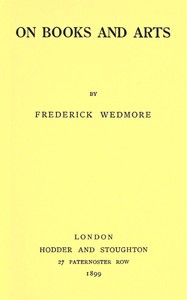
Sir Frederick Wedmore's On Books and Arts opens with a preface that frankly presents the essays as 'contributions' reprinted from periodicals, with only 'a suppression here, and there the alteration of a phrase.' This candor about the occasional nature of the pieces sets the tone for a collection that values the specific occasion over timelessness. The first essay, 'The Short Story,' immediately demonstrates Wedmore's interest in authorial stance: he cites a paradox about actors and life, then applies it to writers, suggesting that romance may be best described by those denied it. This rhetorical move—using a witty analogy to frame a critical point—recurs throughout the volume.

The Paradox of the Practitioner

In 'The Short Story,' Wedmore builds his argument on a series of borrowed paradoxes. He quotes a 'great editor' who claimed the ideal journalist 'did not know too much about his subject,' and Thackeray's protest that no one should write a love story after fifty. These are not mere name-drops; they are structural devices. Wedmore uses them to question the relationship between experience and art, a theme he returns to in later essays. The effect is to position the critic as a mediator between the artist's life and the work's effect, rather than a judge of either alone.

Notably, Wedmore does not resolve these paradoxes. He leaves them suspended, inviting the reader to consider how distance—from subject, from emotion, from fashion—might sharpen perception. This is a consistent authorial choice: his criticism proceeds by juxtaposition, not declaration.

The Vocabulary of Decline in Dutch Art

Wedmore's essay on Dutch seventeenth-century painting reveals a precise diction of artistic decay. He writes of 'the vulgar mimicry of Van Os, with the colours of the chromo-lithograph,' and of Jacob Cats carrying 'to its last length the trivial elaboration which had become the fashion.' The language is evaluative but grounded in observable shifts: from 'home-bred landscape painters' to 'the newer fashion,' from 'supreme art' to 'bastard art.'

His description of Hobbema—'worked on, with great and patient fidelity, but he worked unregarded and died poor'—is a miniature narrative of neglect. Wedmore's choice of verbs ('cast into the shade,' 'faded imperceptibly') gives the history a biological inevitability, yet he also notes the resilience of still life, where 'the early years of the Eighteenth Century surpass the achievements of fifty years before.' The pattern is not simple decline but a redistribution of excellence.

Balzac's Diamond and the Limits of Praise

In the same essay, Wedmore reports Balzac's declaration that Jan Van Huysum's work 'would hardly be paid for if it were covered with diamonds.' He then immediately adds that 'Michael, his kinsman, was perhaps almost as worthy of that praise.' This is a characteristic Wedmore move: he uses an extravagant quotation not to endorse it but to test its boundaries. The phrase 'almost as worthy' introduces a calibration, a critical fine-tuning that refuses hyperbole.

Wedmore's own prose rarely reaches for such dazzle. He prefers the measured, the comparative, the qualified. When he calls Balzac 'a French novelist who was also a connoisseur,' the appositive does double duty: it identifies Balzac's authority while subtly marking his distance from the purely aesthetic. This layering of roles—novelist, connoisseur, source—is typical of Wedmore's method of building authority through accumulation rather than assertion.

The Structure of the Collection as a Critical Act

The table of contents reveals a deliberate architecture. The volume moves from literary essays ('The Short Story,' 'Balzac,' 'George Eliot') to dramatic criticism ('Siddons and Rachel,' 'Macbeth and Irving') to art criticism (Rembrandt, Velasquez, Chardin, etc.). This sequence is not chronological but categorical, and it implies a hierarchy of attention. Wedmore's preface admits that the pieces are 'fragments' not updated, yet their arrangement suggests a coherent sensibility.

Within each section, the essays are ordered by subject's stature or by historical sequence. The art section, for instance, begins with Rembrandt and ends with Francis James, a contemporary. This movement from the canonical to the lesser-known enacts a critical judgment: that the principles applied to great art also illuminate the minor. Wedmore's authorial choice to preserve the essays 'frankly' as contributions means that the collection itself becomes a record of a critic's evolving attention, not a final statement.

Readers approaching On Books and Arts will find a critic who trusts the specific instance over the general rule. Wedmore's essays reward attention to his diction—words like 'fidelity,' 'trivial,' 'bastard' carry weight—and to his habit of embedding others' voices within his own. The collection does not argue a single thesis but demonstrates a method: close observation, historical placement, and a willingness to let paradox stand. It is best read not as a guide but as a series of demonstrations.

Wedmore’s essays carry that quiet ache of things slipping away—how a painting or a line of dialogue holds a moment we barely noticed at the time. Reading him, I keep thinking of A Belated Guest (from Literary Friends and Acquaintance) — Inside the Classic, which feels like the same wistful pause, a welcome long after the party’s ended. Some books are simply a room we’re sorry to leave.

There are no reviews for this eBook.

0
0 out of 5 (0 User reviews )

Add a Review

Your Rating *
There are no comments for this eBook.

Reader reflection

How did this book work for you?

Your answers remain private and are stored only in this browser.

Your progress 0 / 10
1

Which reading stage best describes you?

2

Did this book hold your interest?

3

Would you encourage someone else to read it?

4

Did the language feel accessible?

Related eBooks