1

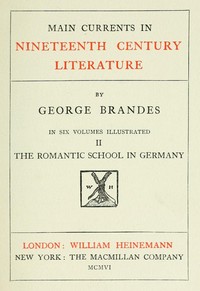
Main Currents in Nineteenth Century Literature - 2. The Romantic School in Germany — Text and Context
(0 User reviews)
2684
Project Gutenberg
2014
Not confirmed
Literature, Modern -- 19th century -- History and criticism; Naturalism in literature; Romanticism
Readers of public-domain and historical texts
Project Gutenberg digital edition
en
Edition facts
Words
119,838
Reading time
522 min
Text sections
13
For Main Currents in Nineteenth Century Literature - 2. The Romantic School in Germany — Text and Context, the stored edition analysis reports 119,838 words, 8 hr 42 min estimated reading time, and 13 detected text sections.
The text analysis averages about 23.6 words per sentence, while the detected sections provide another way to judge how the source is divided.
Project Gutenberg metadata also associates the work with “Literature, Modern -- 19th century -- History and criticism,” connecting these edition facts with the source record’s subject description.
Source:
Project Gutenberg record #47781
Georg Brandes examines German Romanticism through its key figures, tracing a shift from early idealism to later mysticism and psychological fragmentation, with close attention to narrative voice and structural contrasts.
Editorial Edition Score
4.9/5
★★★★★
★★★★★
Calculated from edition completeness, EPUB availability, text structure and catalogue metadata. Not a user rating.
How this score is calculated
- Description quality20 pts
- Title & short description10 pts
- Source metadata20 pts
- Text length15 pts
- Chapters / structure15 pts
- EPUB file integrity20 pts
Total of 100 points, scaled to a 2.5-5.0 range. Editions with an empty description or a missing EPUB file are not scored.
Edition quality
Public-domain source text
Read the source text
The source text is kept in the dedicated reader, separate from this catalogue record and its commentary.
Georg Brandes opens his study of German Romanticism by acknowledging the difficulty a foreign critic faces: the subject is vast, the German literature already exhaustively detailed by native scholars. His solution is to lean on a personal standpoint and the “artistic faculty” of representation—a quality he finds rare among German critics. This self-aware positioning sets the tone for a work that is as much about method as about its subject. Brandes writes as a Dane observing German literary currents, and his outsider perspective yields observations on national character and literary form that a native critic might overlook.
The Foreign Critic’s Advantage
Brandes argues that a foreigner can detect “the mark of race” more easily than a German critic, who is too immersed to see it. This claim is not mere modesty; it shapes the entire volume. He contrasts the German critic’s exhaustive detail with his own emphasis on externalisation and artistic representation. The introduction frames the book as a deliberate act of cultural translation, where the critic’s distance becomes a tool for identifying patterns in voice and structure that might otherwise go unnoticed. Brandes’s own prose mirrors this: he moves swiftly from generalisation to specific example, keeping the narrative pace brisk even when dealing with dense philosophical material.
Hoffmann’s Fractured Selves
In his discussion of E.T.A. Hoffmann, Brandes zeroes in on the split between the judge by day and the fantasist by night. He quotes Hoffmann’s own description of being “at strife with my own Ego,” a phrase that captures the Romantic obsession with doubling and identity. The analysis of Die Elixire des Teufels dwells on the hero Medardus, whose voice dissolves into a stammering, mocking echo of itself. Brandes notes the “strange contrast” between Hoffmann’s official life and his literary one, but he does not reduce the fiction to biography. Instead, he shows how the narrative voice itself becomes unstable—Medardus cannot tell whether he is Viktorin or himself, and the text reproduces that confusion in its shifting pronouns and perspectives.
Pace and the Gothic Cadence
Brandes’s own pacing shifts markedly when he turns to Hoffmann. The earlier chapters move at a measured, analytical tempo; here, the prose accelerates into a breathless catalogue of horrors: “voluptuousness and horrors,” “carnal desires,” “crimes of every kind.” The excerpt from The Elixir of Satan is quoted at length, with its stammered “Me-dar-dus, Me-dar-dus” and the knocking that rises through the floor. Brandes lets the Gothic rhythm dominate, interrupting his own commentary with the raw text. This change in pace is deliberate: it mirrors the Romantic School’s own movement from philosophical idealism to a darker, more visceral mode. The critic’s voice recedes, and the fiction’s own cadence takes over, demonstrating how Romantic literature itself dictates the terms of its analysis.
Brandes’s volume rewards readers who attend to its own narrative voice as much as to the writers it discusses. The shifts in pace—from the measured introduction to the feverish Hoffmann section—are not accidental; they enact the very Romantic tension between control and dissolution that Brandes identifies. A reader alert to these structural choices will find the book as much a performance of criticism as a history of a school.
I’ve shelved Brandes’ Romantic School for decades, always struck by how its early idealism unravels into quiet fragments. There is a tender patience in watching a narrative voice lose itself. That same gentle probing of why we hold to stories lives in Why we should read-- — Edition Insights, a companion I keep nearby, its margins as worn as mine.
There are no reviews for this eBook.
There are no comments for this eBook.
Reader reflection
Your personal reading reflection
Build a private reading journal entry for this title.
Your progress
0
/
10
2
Did this book hold your interest?
3
Would you pass this book on to a friend?
4
How demanding did the text feel?
5
Did anything about the book feel genuinely new?
6
Is this a title worth rereading?
7
How much did the book move you?
8
Did it raise ideas you would like to talk about?
9
In one sentence, what did you learn?
10