
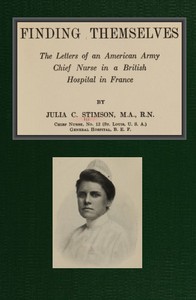
Finding Themselves The Letters of an American Amy Chief Nurse in the British Hospital in France — Reading Companion

(1 User reviews)   293
Stimson, Julia C. (Julia Catherine), 1881-1948, Stimson, Henry A. (Henry Albert), 1842-1936 [Author of introduction, etc.] Project Gutenberg 2019 Not confirmed
World War, 1914-1918 -- Personal narratives; World War, 1914-1918 -- Hospitals Readers of public-domain and historical texts
Project Gutenberg digital edition en

Edition facts

Words 64,267
Reading time 280 min
Text sections 5

This digital edition of Finding Themselves The Letters of an American Amy Chief Nurse in the British Hospital in France — Reading Companion is described by source-level measurements including 64,267 words, 4 hr 40 min estimated reading time, and 5 detected text sections.

The text analysis averages about 19.0 words per sentence, while the detected sections provide another way to judge how the source is divided.

Project Gutenberg metadata also associates the work with “World War, 1914-1918 -- Personal narratives,” connecting these edition facts with the source record’s subject description.

Julia C. Stimson's letters from a British base hospital in France, 1917-1918, show an American chief nurse managing a race-course hospital, coordinating transfusions by candlelight, and recording the daily grind of surgery on wounded Tommies.
Share
Editorial Edition Score 4.7/5

Calculated from edition completeness, EPUB availability, text structure and catalogue metadata. Not a user rating.

How this score is calculated
  • Description quality20 pts
  • Title & short description10 pts
  • Source metadata20 pts
  • Text length15 pts
  • Chapters / structure15 pts
  • EPUB file integrity20 pts

Total of 100 points, scaled to a 2.5-5.0 range. Editions with an empty description or a missing EPUB file are not scored.

Edition quality

Read the Text

, but a few changes seemed to make everybody happy. Some of the nurses are three in a room, but quite a lot of them are only two in a room. With the portholes screwed down there is no difference between the inside and the outside rooms. The whole Pennsylvania Unit, Base Hospital No. 10, is with us, going no one knows where, any more than we do. They seem very nice people, and the Chief Nurse is the Miss Dunlop with whom I had been corresponding about work at the American Ambulance. Miss Dunlop was in charge of the nursing at the Ambulance for some time and can give me lots of pointers about foreign service.

When we reached the _St. Paul_ that Friday evening about 6, going directly from the train to a ferry and from the ferry to the pier, we found the other Unit on board. A committee from the Red Cross was here giving out uniforms. It took not much over an hour and a half before each nurse had received all her things and was free to go. Each one was given caps and armbands, a lovely soft cape lined with bright red flannel; a soft dark blue felt hat, with hat pins, a heavy dark brown blanket, a long heavy double-breasted, dark blue military coat and a dark blue serge dress. The whole equipment is excellent and extremely good in quality and the fit was fine, considering the way measurements had to be sent. There was a box there addressed to every single nurse, each one containing a dress and a coat. The dresses are very good looking. They have high standing collars with a little edging of white at the top and an edging of white at the cuffs. Extra edging was found in an envelope attached to each dress. There is a pleat that runs from each shoulder to the waist and a row of big black buttons follows those pleats. There is also a row of buttons up the outside of each sleeve. At the waist there is a belt and a cloth-covered buckle. The skirt has a pocket on each side and has a panel back. The effect of the whole outfit is very shipshape, though a little somber. There is no distinguishing mark for Chief Nurses, but Miss Noyes, the Chairman of the Bureau of Nursing Service, who came on from Washington to see us off, said she was going to work out some sort of a method for distinguishing the Chiefs and would let us know later what it is to be. A great many of the nurses sent back to their homes the heavy coats they had brought for the steamer. I sent mine.

All the officers and the enlisted men are having regular drill every day. I asked for some drill for the nurses too, and we began yesterday, greatly to the delight of every one, the spectators as well as those participating. We have regular setting-up exercises as well as some military formations so that we can march in decency and order when we have to. On shipboard standing on one foot and raising the other knee is apt to be accompanied with some merriment. And some of our fat doctor officers have more or less difficulty lying down flat on their stomachs and getting up very fast. But by the end of the voyage we all may be very proficient. At any rate it is awfully good for the digestion. Speaking of digestion, we are having excellent food and, as is always the way on a steamer, altogether too much of it. The dining-saloon holds us all at one sitting, which is pleasant. No. 10 takes up all of one side and No. 21 the other and the few civilian passengers sit in the middle.

I was assigned to a very good stateroom all by myself. Then yesterday the purser moved me into a still larger and better room, where I have a table and a droplight, which is more luxury than I ever traveled with before. People are all so good to us. Even the stewards and the stewardesses, most of whom are English, seem to be only too glad to do what they can to make us all comfortable. There have been a few seasick nurses, which is hard to explain, as the weather has been perfect and the ocean very smooth. To-day there is a slight roll, but not enough to notice. Every day there is target practice with the guns. Empty barrels are thrown overboard and the gun crews shoot at them with the big guns that are on the forward and after decks.

Evening prayers are held every evening at 9.30, and yesterday we had church service and had all the enlisted men up. Our [Chaplain] Dean Davis is a real man. We got a choir together yesterday and last evening had some fancy singing, which an overly critical person might call bellowing. It is a mixed choir and it certainly can sing. Now it is time I studied some French.

Friday afternoon, May 25.

Since I last wrote we have had some real weather, and such a lot of sick people! Doctors as well as nurses succumbed; and great was the misery. To-day it is bright and sunny again and not so cold, and everybody is recovering. It was up along the Banks and opposite Labrador, I guess, where it was the worst. It was cold and rainy and really very rough, so much so that we had to have the racks on the tables. I have not been sick a minute myself, but there was one day when I was not much interested in eating. Still I did not miss a single meal.

It is a heavenly day to-day. We are already in or near the danger zone and extra precautions are being taken. It all seems so queer. To-night we are not to undress, and the few nurses who are on the deck below this one, where most of them are, are to sleep to-night in the doctor-officers’ rooms on the upper deck and the latter are to sleep in the sitting-rooms. There has been some special target practice when no passengers were allowed on deck, and there was an elaborate boat drill this afternoon. It is all strange business and still most incomprehensible to me. I still feel as if I were dreaming and that in a few minutes I would wake up. We are due to land Sunday afternoon at Liverpool, it seems, and are scheduled to go to London. But after that all is shrouded in mystery. My crowd of nurses are fine and have been behaving splendidly. Comparing them to the Philadelphia bunch I feel that I have no reason to be ashamed of them or to fear for what they are going to do. They have all shown a splendid spirit and seem to be full of enthusiasm and eagerness to show what Missouri can do when it tries. I feel perfectly sure they are going to be a loyal, hard-working group.

All the nice things that people sent to eat and read have been greatly appreciated. I was just swamped with nice things, but there have been lots of people to enjoy them with me. I have slept and slept and read and read and shall be in fine shape when we land. I was pretty tired when we started and was not sleeping as I should because of the multiplicity of details that were on my mind. Except for the sick nurses the responsibility has let up a lot here on the boat, but will of course begin again when we land. My Squad Leaders have proved most efficient. Miss Dunlop of No. 10 and I have had some very nice talks. I shall be sorry to lose her advice and assistance when we go our separate ways. She is considerably older than I am and much more experienced. For destinations there are rumors of Mesopotamia, Saloniki, Russia, England, and the North of France. Take your choice. It’s a great game to be traveling thousands of miles and not know where you are going, nor how long you are going to stay, nor really what you are going to do when you get there. We may even be in camp somewhere. All the camp equipment is with us. Well, I like the game anyway.

Last night all my dear little nurses [in St. Louis] were having their graduation exercises without me. I hope they got the little speech I sent them, poor as it was. We were thinking of them. One of the men at our table is keeping one of his watches at St. Louis time, so at every meal we discuss what is going on in St. Louis.

When this letter reaches you, you will know that everything is well with us. You will know that before then, come to think of it. For it will take a long time for letters to get back to the U. S. A. It is going to be ages before we shall receive letters from you, worse luck.

I have enjoyed Elsie’s ginger and her book ever so much and Mother’s wonderful Dean box is going to continue to be a delight for a long time. I am going to try to take the box along for eats, and to keep it for that. I am not sure yet just how much luggage I can manage and I seem to have accumulated a good deal more than I started with. The Ever Warm Safety Suit is awfully nice to have. I trust I shall not have to use it, but it is nice to have around anyway. There are several of them on the boat.

This letter can be kept just for the family. I am writing others to St. Louis. I do hope Philip[2] will be coming along over soon and that it won’t take long to find out where he is.

Don’t you worry about me one least little bit. I am having the time of my life and wouldn’t have missed it for anything in the world.

Good-by for now. I hope all your summer plans will work out smoothly and happily for you all.

Sat. May 26.--First night in danger zone safely passed and everything O.K. My bunch all went to bed and slept finely.

Liverpool, The Adelphi Hotel.

Monday, May 29, 1917.

I do not know how I am ever going to manage to write down all the things I am learning and all the wonderful impressions that are beginning to crowd upon me. But I feel as though I could not bear to lose them; and so many new ones will come every day, I surely will lose them if I don’t write them down at once.

We arrived last evening but did not dock until this A.M. at 7.30. We were met by a Colonel B., who said he came to welcome us in the name of the Director-General and the King. He was an extremely affable old tall thin boy in a much-decorated uniform and a swagger stick. He told us we were to stay in Liverpool 24 hours, the nurses at the Adelphi and the doctors at the Northwestern, and that to-morrow at 11 we are to be conducted to London, to stay there at the Waldorf Hotel four or five days, and then to be sent to France. He said the Cleveland Unit had already been sent over, the Boston one was to go to-day, and the New York one Wednesday. The Philadelphia Unit and we are to stay together as far as London, but will be sent to separate destinations. We know where we are to go, but if I should tell you now the censor would cut it out. We can tell you later, not before. Anyway we are delighted, for we are to have lots of work, and mighty hard work too. We have been told considerable details about what we are to do, but I shall have to wait before I can tell you about it all.

We reached the hotel about 11 and were assigned to rooms with the greatest dispatch and courtesy. I have a most luxurious room and bath. After lunch I gave some directions to the squad leaders[3] about letting the nurses do what they wanted the rest of the day, in parties not larger than four, etc., in order not to be conspicuous, and then I came upstairs to sit down in quiet and read the paper and rest. I took a nice little nap and had a perfectly good bath, and a little before five was telephoned to that Miss Dunlop, the Chief Nurse of No. 10, and a Colonel J. wished me to come down to tea. I went on down and found Miss D., Colonel B., and Colonel J. in the lounge, which was filled with a gay crowd of people having tea and listening to the orchestra. There were lots of uniforms, and many limping, bandaged soldiers, and I had my first heartache over the one-legged young officers.

Pretty soon Colonel J., who is the English member of the R. A. M. C. (Royal Army Medical Corps) who is to escort us nurses to London to-morrow, went and brought over to our table a friend of his, a Major F., also R. A. M. C. This last man was a lean, hollow-eyed man of about 40, who pretty soon got talking, and for the next hour I heard such tales as I hardly ever thought could be true. He had been a German prisoner of war for eleven months. On the way to the prison camp he had been kept in a railway carriage without food or water for three days. At German towns through which the train passed and where they always stopped, he said it frequently happened that women in Red Cross uniforms came to the stations and offered the prisoners cups of tea or milk and held them to their lips, only to snatch them away again and jeer and call them “schweinhund.” He told of the treatment in the camps, where the prisoners in the dead of winter had only the rags of their uniforms to wear, their great coats had been taken away from them, and they slept on sacks of straw without even a tent or any kind of a roof over them. He said he saw men die at the rate of seven a day from starvation. He said he never in all his hospital experience has seen such emaciation from either cancer or tuberculosis as he saw among the prisoners there who were starving. He saw men kiss the shoes of their guards and beg like babies for bread. Not the British Tommies but some of the other prisoners did this. The men had no opportunity to wash and no soap. Their beards and hair hung down to their waists and were alive with lice. He was in several different prison camps. The final one was one where he was sent as a punishment for writing a letter of protest to the American Ambassador. The letter was never delivered, and he was sent to a camp where he was the only British person among thousands of Russians. He had complained because parcels sent to prisoners by their friends were not delivered to them but were allowed to rot and mildew and be eaten by rats. He was exchanged after eleven months’ torture, he called it, in January, 1916. He himself had dysentery and scurvy but not typhus. After he recovered he was put in charge of a hospital ship, which was recently torpedoed. Of the 600 sick and wounded that he had on board he lost only 27.

He told of a hospital ship crossing the Channel just behind his ship on one trip within 500 yards of his ship and of its striking a mine. There were no wounded on board at the time, but 12 nurses and officers and crew. One of the destroyers which was convoying his ship went to the rescue and got alongside the sinking hospital ship and a little French trawler also got alongside. Nine of the 12 nurses and the men all jumped and landed on the destroyer, but no sooner were they on that boat than it also struck a mine and was blown to atoms, and everybody on it and on the trawler was blown to bits. The three nurses who were in the water were picked up by Major F--’s boat. He is here in Liverpool fitting up another hospital ship and will probably be ordered East again to bring back more wounded.

He asked if Miss Dunlop and I would like to see his ship. Would we? We got our coats in a jiffy and flew off with him in a taxi to one of the docks quite a way off. His boat is a big ship that was a passenger ship between here and South America. He has taken out the cabins and made big wards and has accommodations for 800 sick or wounded men. I never saw anything so cleverly done as the way he is making over that ship. He has a splendid operating room, an X-Ray complete equipment, a steam laundry, and absolutely everything that a modern big city hospital has. It will be ready to sail, he said, in ten days, although to us there seemed to be an enormous amount yet to do. They no longer have women nurses on the hospital ships.

We came back from the dock by an “overhead” tram and got here about eight o’clock, although it was as light as four o’clock. Miss Dunlop and I then went to dinner together. Ruth Cobb and Rachel Watkins (our nice dietitian) spent the afternoon in Chester and had a wonderful time, they said. People are so wonderfully nice. The kids on the street salute us, and people come up and ask if we aren’t American nurses and if they can’t do something for us, and take nurses to tea and put them on the proper trams and show them all sorts of courtesies.

I had just come in to start to write, about nine o’clock, when Major Murphy[4] was announced, and I went down to see him. He had called to see if there was anything he could do for us and to find out if we were all right. They are so considerate and good to us. I told him of our wonderful experience this afternoon, and just then Colonel J. and Major F. hove in sight and as I wanted Dr. Murphy to hear some of Major F--’s tales I introduced him, and soon left them, to come up here and write.

It is now almost eleven and Miss Dunlop has been in to tell me the latest instructions she has received from her Majors. We always have to compare instructions and see which of us knows the most about what is going to happen. If we have the same experiences as the nurses of the two previous Units, we are to be much fêted in London, and are to be reviewed by the Queen. We have been trying desperately hard on shipboard to learn how to march and keep step and to right about face without falling over ourselves, but I fear we won’t be much on looks when it comes to being reviewed. I trust we are not expected to curtsy. And now I must hustle to bed, for to-morrow will be an exciting day. Good night and so much love to you all. If only you were all having this wonderful experience with me nothing more could be desired.

Wednesday, June 6, 1917.

Julia C. Stimson's letters, written between May 1917 and June 1918, open with a rush: less than a week's notice to mobilize sixty-five Red Cross nurses for France. The first letter, dated May 4, 1917, from St. Louis, captures the frantic preparation—"most of the nurses are ready, but it is quite certain we won't be leaving for several days." The book's subtitle, The Letters of an American Army Chief Nurse in a British Hospital in France, accurately describes its content, but the catalog subject "Fantasy & Juvenile Worlds" is a misclassification. These are not fantasies but firsthand accounts of surgery, supply shortages, and air raids.

A Race-Course Hospital and Its Daily Reality

The letters describe a British base hospital established on a race course, where Stimson's unit cared for "from eight hundred to two thousand wounded 'Tommies' at a time." The setting is not merely a backdrop but a functional space: operating huts, a "Theatre Hut" for surgery, and wards where patients hold oil lanterns to avoid being stepped on during blackouts. The excerpts show a nurse's-eye view of logistics—ordering "heavily reënforced" supper for night staff, scrubbing up for sterile procedures, and dashing for candles during an air raid. The catalog lists "World War, 1914-1918 -- Hospitals" as a subject, and the letters bear this out, but they also reveal the hospital as a makeshift, adaptive environment where race-course architecture is repurposed for triage and recovery.

Transfusion by Candlelight: A Set Piece of Wartime Medicine

One of the most detailed episodes describes a blood transfusion performed under emergency conditions. A donor is recruited from among the walking wounded, promised a trip to England as incentive. The procedure is intricate: "a nurse was holding a droplight over the bed, another nurse was holding the arm, a doctor was adjusting the tourniquet." When the lights fail, Stimson retrieves candles, and the team continues by their light, moving ether bottles away to prevent explosion. The patient stops breathing; the doctors "came in from working over the dead man." This passage, spanning several pages, illustrates the improvisation and mortality that defined base hospital work. The catalog subject "Personal narratives" fits, but the excerpt shows that these are not retrospective memoirs but immediate, unpolished letters—Stimson writes as events unfold, without literary framing.

Voice and Structure: The Letter as Record

Stimson's letters are addressed to "Dearest Mother and Dad," a framing that shapes their tone: intimate, hurried, and unguarded. She reports thirty-four operations in twenty-four hours, notes that some patients "screamed and fought and cursed" under ether, and describes a paralyzed man with shrapnel in his spine. The prose is factual, with occasional dry humor—an acetylene lamp is "quite all right for emergencies if you have about ten minutes in which to start it." The letters were written "with no thought of publication," as Henry A. Stimson's introduction states, and this origin explains their lack of narrative arc. They do not build toward a climax; they simply record. The catalog's "Fantasy & Juvenile Worlds" category is contradicted by the graphic, unsentimental content. Readers should approach the book as a documentary artifact, not a constructed story.

The letters in Finding Themselves offer a granular view of American nurses working under British command in 1917-1918. Because the excerpts are incomplete, the full scope of Stimson's experience—whether she describes later battles, the influenza pandemic, or the armistice—is unknown. Readers interested in the history of military nursing, medical logistics, or women's wartime writing will find these letters a primary source of daily operations, free of retrospective gloss. The book's value lies in its immediacy and specificity, not in any overarching argument.

I remember Miss Stimson’s letters, those candlelit blood transfusions, and how she held her nurses together. It put me in mind of another steady hand, Booker T. Washington’s, in Character Building Being Addresses Delivered on Sunday Evenings to the Students of Tuskegee Institute — Inside the Classic. Both speak of quiet fortitude, of making do, of tending one’s own post without complaint. A kindred calm between them.

Benjamin Campbell
4 weeks ago

5
5 out of 5 (1 User reviews )

Add a Review

Your Rating *
There are no comments for this eBook.

Reader reflection

How did this book work for you?

Your answers remain private and are stored only in this browser.

Your progress 0 / 10
1

Have you finished this book?

2

What was your overall reaction to the book?

3

Would you pass this book on to a friend?

4

Did the language feel accessible?

Related eBooks