1

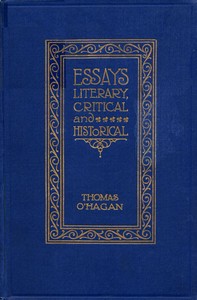
Essays Literary, Critical and Historical — A Closer Reading
(0 User reviews)
2958
Project Gutenberg
2016
Not confirmed
Literature -- History and criticism; Tennyson, Alfred Tennyson, Baron, 1809-1892. Princess; Catholic Church -- Controversial literature -- History and criticism; Literature -- Study and teaching -- Ontario
Readers of public-domain and historical texts
Project Gutenberg digital edition
en
Edition facts
Words
23,877
Reading time
104 min
Text sections
4
The catalog record for Essays Literary, Critical and Historical — A Closer Reading provides practical reading context through 23,877 words, 1 hr 44 min estimated reading time, and 4 detected text sections.
The text analysis averages about 28.6 words per sentence, while the detected sections provide another way to judge how the source is divided.
Project Gutenberg metadata also associates the work with “Literature -- History and criticism,” connecting these edition facts with the source record’s subject description.
Source:
Project Gutenberg record #51593
Thomas O'Hagan's 1909 collection of five essays argues for a spiritually informed literary study, critiques Tennyson's 'The Princess,' and defends Catholic truth against misrepresentation in history and poetry.
Editorial Edition Score
4.6/5
★★★★★
★★★★★
Calculated from edition completeness, EPUB availability, text structure and catalogue metadata. Not a user rating.
How this score is calculated
- Description quality20 pts
- Title & short description10 pts
- Source metadata20 pts
- Text length15 pts
- Chapters / structure15 pts
- EPUB file integrity20 pts
Total of 100 points, scaled to a 2.5-5.0 range. Editions with an empty description or a missing EPUB file are not scored.
Edition quality
Read the Text
blind his soul with clay.”
As to the characters of the two kings, they are well conceived and drawn. Ida’s father has an easy, loving disposition, and it is very evident that she inherits her strength of character from her mother. The Northern King is of a rough and violent type, which recalls the time when marriage was a capture:
“Look you—Sir! Man is the hunter; woman is the game; The sleek and shining creatures of the chase, We hunt them for the beauty of their skins; They love us for it and we ride them down.”
While the character of Florian is vague and indefinite, that of Cyril is well and clearly conceived. The latter is a wholesome, jovial and honest-hearted fellow. He is no dreamer and can always tell the substance from the shadow. He is not at all impressed by stately women, and so he tells the Princess that Love and Nature are more terrible than she.
The two widows, Lady Psyche and Lady Blanche, are in sharp contrast to each other. The former remains womanly under every circumstance. Even when discoursing on the nebular hypothesis in the lecture-room, we find that her babe, sweet Agläea, is by her side, and when she has lost it she bitterly reproaches herself for having left it behind.
Lady Blanche is the most unlovely woman in the whole gallery of Tennyson’s women. She has no thought but for herself, and even asperses the memory of her dead husband. She is full of envy and jealousy, nor has she even the affection of a mother for her sunny-hearted and winsome daughter, Melissa. She is a type of not a few who identify themselves with the Woman’s Rights movement of to-day, ostensibly to better the social and intellectual position of woman, but virtually to blow a bubble before the eyes of the world and gather about them an atmosphere of notoriety.
Having analyzed the poem as to its motive and plot, and shown the part which each character contributes to the development of the plot, we will now consider the purpose and import of the songs or ballads which the young ladies sing during the pauses or interludes in the poem. The songs did not appear at first, but were added by the poet to the third edition, which appeared in 1850. It will be noticed that they nearly all relate to children, and serve as choruses to guide and interpret the sympathies of the reader in the progress of the poem. Let us take them in their order, one by one. The first tells of a quarrel between a man and his wife, and of the reconciliation caused by the memory of their dead child:
“As thro’ the land at eve we went, And pluck’d the ripen’d ears, We fell out, my wife and I, O we fell out I know not why, And kiss’d again with tears. And blessings on the falling out That all the more endears, When we fall out with those we love And kiss again with tears! For when we came where lies the child We lost in other years, There above the little grave, O there above the little grave, We kiss’d again with tears.”
Here we have the abiding influence of the child reaching back from the grave and uniting by its memory the tearful and desolate hearts of the estranged parents.
The second represents how the toil and labor of the father are ennobled and lightened amid the perils of the deep through the memory of the little babe for whose life and love he fondly braves every danger:
“Sweet and low, sweet and low, Wind of the western sea, Low, low, breathe and blow, Wind of the western sea! Over the rolling waters go, Come from the dying moon, and blow, Blow him again to me, While my little one, while my pretty one, sleeps.
“Sleep and rest, sleep and rest, Father will come to thee soon; Rest, rest, on mother’s breast, Father will come to thee soon; Father will come to his babe in the nest, Silver sails all out of the west Under the silver moon: Sleep, my little one, sleep, my pretty one, sleep.”
Sweet influence, indeed, this of the babe which reaches across the ocean and unites loving hearts.
Thomas O'Hagan opens his 1909 collection with a pointed defense of Tennyson's 'The Princess,' a poem he claims has been 'singularly underrated and misunderstood' since its birth. Drawing on Dr. S. E. Dawson's analysis, O'Hagan positions his study as a corrective to adverse criticism. The preface reveals a dual purpose: to champion a spiritual, anti-analytical approach to literature and to counter what he sees as the misrepresentation of Catholic truth in contemporary history and poetry. The essays, four previously published in Catholic periodicals, blend literary criticism with educational polemic, reflecting O'Hagan's experience teaching in Ontario high schools and his postgraduate studies at American universities.
A Polemic Against Analytical Reading
In 'The Study and Interpretation of Literature,' O'Hagan launches a sustained attack on what he calls 'brilliant analytics' that reduce poems to 'barren abstraction.' He insists that the 'spiritual element constitutes the INFORMING life of a poem' and that teachers who focus on grammar or historical linguistics—tracing 'the gerundial infinitive through Chaucer’s “Canterbury Tales”'—miss the essence of literature. His solution is radical: better to turn students loose in a library to browse freely than to subject them to examinations that 'dull the finer faculties of appreciation.' O'Hagan quotes Brother Azarias's definition of literature as 'the verbal expression of man’s affections' and cites Ruskin on the value of studying a few epochal cities. The tone is urgent, even exasperated, as he warns that 'literature is a jealous mistress and will brook no rival.'
The Case for a Canon of Twenty
O'Hagan proposes a focused canon of twenty authors—Homer, Virgil, Dante, Calderon, Molière, Goethe, Chaucer, Spenser, Shakespeare, Milton, Wordsworth, Tennyson, and others—as sufficient to cover 'the best poetic thought in all ages.' He contrasts these with the 'flood of ephemeral literature—chiefly novels' that he believes corrupt literary taste. This argument appears in the essay on literary study, but its implications ripple through the volume. O'Hagan's own essays, however, do not strictly adhere to this canon; he writes on Tennyson and the Italian Renaissance, but also on Catholic controversies and educational reform. The tension between his prescriptive ideal and his broader practice suggests a pragmatic willingness to engage with contemporary debates.
Voice and Structure: A Recurring Urgency
O'Hagan's prose is marked by a recurring rhetorical pattern: he states a problem, diagnoses its cause, and prescribes a remedy, often with italicized emphasis. In the preface, he declares that 'the courage to state the truth is a more valuable asset of character than the gift of bestowing false praise.' This combative stance reappears in his critique of examinations and his defense of Catholic truth. The essays vary in pace: the Tennyson study is measured and analytical, while 'Poetry and History Teaching Falsehood' adopts a more accusatory tone. O'Hagan frequently addresses the reader directly—'Let the reader, divested of every predilection and bias, examine it carefully'—creating a sense of personal engagement. His sentences are often long and periodic, building to a climactic point, as when he quotes Mrs. Browning on the proper way to read a book.
O'Hagan's essays reward readers who attend to his recurring concerns: the primacy of spirit over method, the danger of misreading history, and the need for a disciplined literary education. His voice is that of a teacher-critic, earnest and occasionally dogmatic, but grounded in specific institutional experience. The collection offers a window into early twentieth-century Catholic intellectual life in Canada, and into the debates about literary study that still resonate today.
Years ago, I shelved O’Hagan’s essays and felt his quiet insistence that true learning shapes the soul. It reminded me of another gentle voice, one that spoke to students not of theories, but of daily character—Character Building Being Addresses Delivered on Sunday Evenings to the Students of Tuskegee Institute — Inside the Classic—two books holding the same old lamp, each in its own room.
There are no reviews for this eBook.
There are no comments for this eBook.
Reader reflection
What did you think of this book?
Answer a few questions and save a private reflection on this device.
Your progress
0
/
10
2
Was reading this book enjoyable?
3
Would you recommend this book to another reader?
4
How easy was the book to follow?
5
Did the book deliver what you hoped for?
6
How original did the book feel?
7
How valuable was this book for your own interests?
8
How closely did the book connect with your experience?
9
Which lesson or insight stayed with you?
10