1

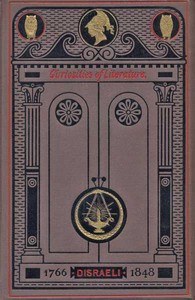
Curiosities of Literature, Vol. 1 — Key Ideas to Explore
(0 User reviews)
2931
Project Gutenberg
2007
Not confirmed
English literature -- History and criticism; Literature -- Anecdotes; Litterateurs
Readers of public-domain and historical texts
Project Gutenberg digital edition
en
Edition facts
Words
204,283
Reading time
889 min
Text sections
24
For Curiosities of Literature, Vol. 1 — Key Ideas to Explore, the stored edition analysis reports 204,283 words, 14 hr 49 min estimated reading time, and 24 detected text sections.
The text analysis averages about 24.0 words per sentence, while the detected sections provide another way to judge how the source is divided.
Project Gutenberg metadata also associates the work with “English literature -- History and criticism,” connecting these edition facts with the source record’s subject description.
Source:
Project Gutenberg record #21615
Isaac Disraeli's miscellany of literary anecdotes, edited by his son Benjamin, explores curious customs, forgotten lore, and eccentric figures from English and European letters, drawing on antiquarian sources and personal observation.
Editorial Edition Score
4.9/5
★★★★★
★★★★★
Calculated from edition completeness, EPUB availability, text structure and catalogue metadata. Not a user rating.
How this score is calculated
- Description quality20 pts
- Title & short description10 pts
- Source metadata20 pts
- Text length15 pts
- Chapters / structure15 pts
- EPUB file integrity20 pts
Total of 100 points, scaled to a 2.5-5.0 range. Editions with an empty description or a missing EPUB file are not scored.
Edition quality
Read the Text
Republic was himself a child of Israel. But towards the middle of the eighteenth century, the altered circumstances of England, favourable, as it was then supposed, to commerce and religious liberty, attracted the attention of my great-grandfather to this island, and he resolved that the youngest of his two sons, Benjamin, the "son of his right hand," should settle in a country where the dynasty seemed at length established, through the recent failure of Prince Charles Edward, and where public opinion appeared definitively adverse to persecution on matters of creed and conscience.
The Jewish families who were then settled in England were few, though, from their wealth and other circumstances, they were far from unimportant. They were all of them Sephardim, that is to say, children of Israel, who had never quitted the shores of the Midland Ocean, until Torquamada had driven them from their pleasant residences and rich estates in Arragon, and Andalusia, and Portugal, to seek greater blessings, even than a clear atmosphere and a glowing sun, amid the marshes of Holland and the fogs of Britain. Most of these families, who held themselves aloof from the Hebrews of Northern Europe, then only occasionally stealing into England, as from an inferior caste, and whose synagogue was reserved only for Sephardim, are now extinct; while the branch of the great family, which, notwithstanding their own sufferings from prejudice, they had the hardihood to look down upon, have achieved an amount of wealth and consideration which the Sephardim, even with the patronage of Mr. Pelham, never could have contemplated. Nevertheless, at the time when my grandfather settled in England, and when Mr. Pelham, who was very favourable to the Jews, was Prime Minister, there might be found, among other Jewish families flourishing in this country, the Villa Reals, who brought wealth to these shores almost as great as their name, though that is the second in Portugal, and who have twice allied themselves with the English aristocracy, the Medinas--the Laras, who were our kinsmen--and the Mendez da Costas, who, I believe, still exist.
Whether it were that my grandfather, on his arrival, was not encouraged by those to whom he had a right to look up,--which is often our hard case in the outset of life,--or whether he was alarmed at the unexpected consequences of Mr. Pelham's favourable disposition to his countrymen in the disgraceful repeal of the Jew Bill, which occurred a very few years after his arrival in this country, I know not; but certainly he appears never to have cordially or intimately mixed with his community. This tendency to alienation was, no doubt, subsequently encouraged by his marriage, which took place in 1765. My grandmother, the beautiful daughter of a family who had suffered much from persecution, had imbibed that dislike for her race which the vain are too apt to adopt when they find that they are born to public contempt. The indignant feeling that should be reserved for the persecutor, in the mortification of their disturbed sensibility, is too often visited on the victim; and the cause of annoyance is recognised not in the ignorant malevolence of the powerful, but in the conscientious conviction of the innocent sufferer. Seventeen years, however, elapsed before my grandfather entered into this union, and during that interval he had not been idle. He was only eighteen when he commenced his career, and when a great responsibility devolved upon him. He was not unequal to it. He was a man of ardent character; sanguine, courageous, speculative, and fortunate; with a temper which no disappointment could disturb, and a brain, amid reverses, full of resource. He made his fortune in the midway of life, and settled near Enfield, where he formed an Italian garden, entertained his friends, played whist with Sir Horace Mann, who was his great acquaintance, and who had known his brother at Venice as a banker, eat macaroni which was dressed by the Venetian Consul, sang canzonettas, and notwithstanding a wife who never pardoned him for his name, and a son who disappointed all his plans, and who to the last hour of his life was an enigma to him, lived till he was nearly ninety, and then died in 1817, in the full enjoyment of prolonged existence.
My grandfather retired from active business on the eve of that great financial epoch, to grapple with which his talents were well adapted; and when the wars and loans of the Revolution were about to create those families of millionaires, in which he might probably have enrolled his own. That, however, was not our destiny. My grandfather had only one child, and nature had disqualified him, from his cradle, for the busy pursuits of men.
Isaac Disraeli's Curiosities of Literature, here presented in a new edition edited by his son Benjamin Disraeli, is a sprawling miscellany that resists easy categorization. The work collects anecdotes, historical oddities, and critical observations on literary and cultural history, ranging from the origins of glove-giving customs to the medieval trade in saintly relics. The editor's preface frames the author's life as one of sustained intellectual purpose, arguing that a book may be as consequential as a battle—a claim that sets the tone for a volume where the trivial and the significant are deliberately intertwined.
Anecdotal Method and Antiquarian Sources
Disraeli's method is associative rather than systematic. He moves from a discussion of maiden assizes and the custom of removing gloves in princely stables to the phrase giving a pair of gloves, citing Gough's Sepulchral Monuments and records of glove sales from the Earl of Arran's goods. The author does not always explain the origins of these customs; he notes that the reason for removing gloves in German stables 'seems to be lost.' This willingness to present unresolved curiosities is characteristic. He draws on antiquarian authorities such as Chambers and Gough, but also on sale catalogues and family heirlooms, as when he records that gloves given by Henry VIII to Sir Anthony Denny were sold for 38 l. 17 s. The texture of the prose is dense with proper names and specific sums, lending an air of documentary precision even when the underlying rationale remains obscure.
Relics, Credulity, and the Commerce of the Sacred
The section on 'Relics of Saints' exemplifies Disraeli's interest in the intersection of belief and commerce. He describes the 'relique-mania' as a universal phenomenon where buyers and sellers engaged in 'curious impositions' and theft. He cites Guibert de Nogent's treatise against false relics, written after monks at St. Medard de Soissons claimed to possess a tooth of Christ. Disraeli reports with evident relish that Guibert denounced as 'chimerical' the belief that someone owned the navel of Christ's body. The account of St. Lewin's translation from England to Bergs includes the 'knavish modes' used to steal fragments of the saint. Disraeli's tone is detached but pointed; he does not mock the faithful but highlights the gap between the 'good faith' of purchasers and the 'impositions' of vendors. The passage reveals a collector's fascination with the mechanics of fraud and the social logic of relic-hunting.
The Editor's Frame: Biography as Defense
Benjamin Disraeli's prefatory 'Life and Writings' provides a biographical lens that shapes how the miscellany is presented. He argues that an author's life is as eventful as a statesman's, citing Voltaire, Homer, and Bacon as figures whose 'exploits' rival military victories. This defense of literary labor is pointed: Isaac Disraeli's career, Benjamin claims, exhibited 'uniformity more sustained' than most, with a 'strong bent' pursued from infancy to old age. The son's notes, added to this edition, are said to 'illustrate or correct' the text where later discoveries have superseded the father's knowledge. This editorial apparatus frames the Curiosities not as a relic but as a living document, open to revision. Benjamin's intervention also signals a shift in readership: the volumes are now offered to 'the young and ardent inquirer after knowledge,' suggesting an educational purpose that the original may not have explicitly claimed.
Readers approaching this volume should expect a work that prioritizes curiosity over argument. Disraeli's essays do not build toward a thesis; they accumulate details, often leaving the reader to draw connections. The editor's notes and biographical introduction provide context but do not resolve the miscellany's inherent looseness. For those interested in the byways of literary history, the customs of glove-giving, or the economics of relic fraud, this collection offers a wealth of specific, often surprising, information—provided one is willing to follow the author's digressive path.
There’s something tender about a father collecting oddities and a son later preserving them—generations holding the same page. Reading Disraeli’s miscellany feels like inheriting a quiet, cluttered study. I keep thinking of how those fragile treasures carried on through darker years, much like the voices gathered in The Great War in Verse and Prose — Background and Themes, each one a small, stubborn light against forgetting.
There are no reviews for this eBook.
There are no comments for this eBook.
Reader reflection
Before you leave, reflect on the book
Use these questions to collect your thoughts before moving on.
Your progress
0
/
10
2
How much did you enjoy the reading experience?
3
How likely are you to recommend this book?
4
How much effort did this book require?
5
How clearly were the main ideas presented?
6
What did you appreciate most?
7
Would you start a conversation about this book?
8
Did this book create an emotional response?
9
In one sentence, what did you learn?
10