
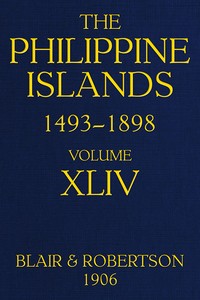
The Philippine Islands, 1493-1898, Volume 44, 1700-1736 by Emma Helen Blair et al.
Okay, let's be clear from the start: this is not a novel. 'The Philippine Islands, 1493-1898, Volume 44' is a piece of a massive, 55-volume historical project. This specific book covers the years 1700 to 1736. There's no plot in the traditional sense. Instead, editors Emma Helen Blair and James Alexander Robertson compiled and translated a bunch of original documents from that time. We're talking official letters from governors to the king in Spain, reports from religious orders, legal decrees, and accounts of events written by the people who lived them.
The Story
The 'story' here is the slow, grinding administration of a colony. You'll read about the constant power struggles between Spanish civil authorities and the powerful religious orders (especially the Jesuits, Dominicans, and Augustinians). There are detailed accounts of military efforts against Muslim groups in the south, like the Moros, and the ongoing challenge of defending remote islands. You'll see the bureaucracy in action: arguments over taxes, trade restrictions with China and Mexico, and the complicated social structure that placed Spanish-born officials above those born in the islands. It's a raw, unfiltered look at the gears of empire, complete with all the paperwork.
Why You Should Read It
I love this book because it lets the past speak for itself, with all its biases and blind spots intact. You're not getting a historian's smooth narrative. You're getting the frustrated governor complaining that he has no money or ships. You're reading the priest's worried report about a village that's resisting conversion. This direct access creates an incredible sense of immersion. You start to see the colony not as a monolith, but as a collection of individuals—often at odds with each other—trying to make a system work across impossible distances. The themes are timeless: power, faith, cultural clash, and the sheer difficulty of governance.
Final Verdict
This is a niche read, but a rewarding one. It's perfect for serious history students, writers researching the colonial era, or anyone with a deep curiosity about Philippine history who wants to go beyond textbooks. It's not for casual readers looking for a quick story. You have to be willing to sift through dense, formal language and appreciate history in its raw, documentary form. If that sounds like you, this volume is a treasure trove. It's a window into a world usually summarized in a paragraph, and seeing it in such detail is genuinely special.
Jennifer Harris
7 months agoThe index links actually work, which is rare!
Andrew Wright
9 months agoNot bad at all.
Kenneth Hill
1 year agoI was skeptical at first, but the flow of the text seems very fluid. Don't hesitate to start reading.
Sandra Perez
3 weeks agoAfter finishing this book, the atmosphere created is totally immersive. Thanks for sharing this review.
Logan Young
1 year agoHonestly, it manages to explain difficult concepts in plain English. Worth every second.